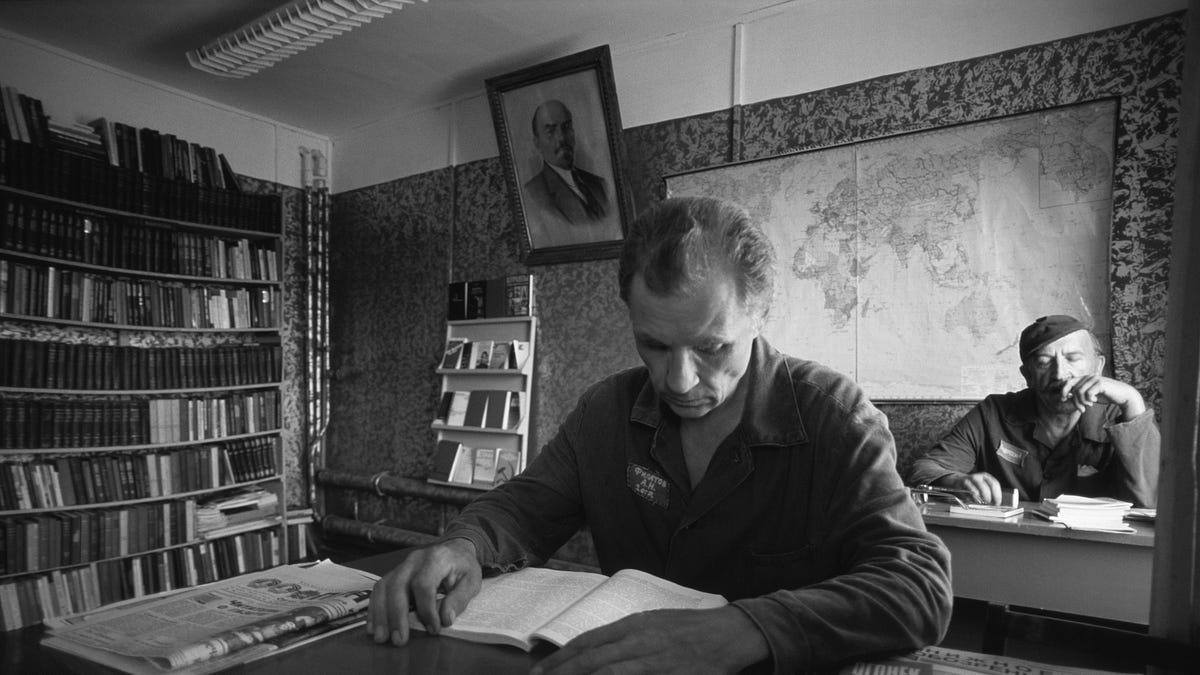
Natan Sharansky, the Soviet dissident and author of Fear No Evil, writes that the most extensive library of classic literature he encountered in the USSR was not in a university or a private home. It was inside Lefortovo, the KGB's most notorious prison.
Sharansky spent 16 months at Lefortovo, from his arrest in March 1977 to his trial in July 1978, undergoing more than 100 interrogations. It was there, he writes, that he had his second encounter with Socrates.
The library's origin was grim. Sharansky calls it "the twisted legacy of Joseph Stalin's purges," when members of Moscow's intelligentsia were killed and their property seized. The confiscated books went through what he describes as a rigorous redaction process — to strip out the names of any "enemies" — before being distributed to KGB organs, Lefortovo among them.
Growing up, Sharansky recalls, his family's home held more than a thousand books, most of them classic literature. The reason was practical: modern literature was heavily censored and had to conform to socialist realism, the genre in which, as he puts it, "the oppressed working class is always right and the capitalist oppressors are invariably doomed to defeat." The older a book, the more likely it had survived the censors. Reading the classics, he writes, was "a kind of escapism" — a way to enter a world free of the KGB's presence.
He first met Socrates at 15, reading from his family's library. That meeting, he says, was formal and distant; the philosopher's logic required context he did not yet have patience to study. He knew Socrates chiefly by his fate — sentenced by his own city, Athens, to death by poison in the fifth century BCE, for denying the gods and corrupting the youth — and by a line every intelligent Jewish schoolboy liked to quote: "We have to drink our cup to the end."
The deeper reading came later, inside Lefortovo, where Sharansky says the philosopher became something closer to company.
The irony he draws out is precise, and it is worth sitting with. A state that seized private libraries to punish dissent ended up, by its own bureaucratic logic, stocking its most feared prison with the very texts that could outlast it. The KGB could redact names. It could not redact Plato's arguments, or the fact that a mind trained on them does not stop reasoning simply because it has lost its liberty.
That is the trade-off totalitarian systems never fully solve. They can nationalize property, censor the present, and control what gets published — but the classics, once absorbed, travel with a person into the cell. Sharansky's account is a reminder that ownership of books was never really the point; the state that confiscates a library still cannot confiscate what a prisoner has already read. What is true does not need an adjective, and neither, it turns out, did Socrates need a KGB stamp of approval to keep making his case — even from inside the institution built to silence him.