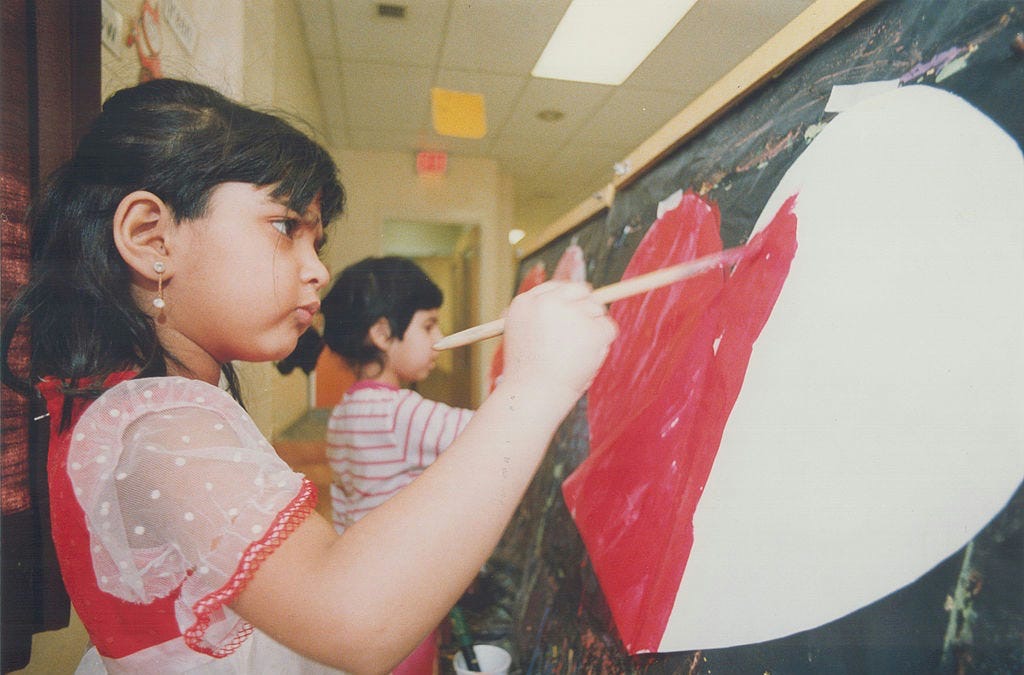
As the end of kindergarten neared for Kelsey Padgett's 5-year-old daughter, Emersyn, the Michigan mother started getting nervous.
Emersyn was born at the end of July, making her among the youngest kids in her class. "I don't think that's ever a good thing," Padgett, a former kindergarten and first-grade teacher, told The Free Press.
Academically, Emersyn was doing fine. "Emersyn was really good at academics," Padgett said, "but socially..." She paused. "She's fine now," Padgett said — but she was thinking further down the line, to middle school, where social maturity would matter in making friends, in dating, in navigating a world with potential bullies.
So Padgett went to the school's office and told them her daughter would be repeating kindergarten. She did not wait for a teacher, a counselor, or a policy memo to tell her that. She made the call herself.
She is not alone. One Florida mother, describing the same instinct playing out among other families, put it more bluntly: "People will do anything to get an edge. At what point does it become too ridiculous? When does it stop?"
That question — hers, not ours — is the honest one. It captures both sides of the same decision: the parent who sees a real developmental gap and the parent who sees a competitive one. The record, as reported, does not tell us which kind of parent is more common. It tells us only that the decision is being made, family by family, outside the machinery of the school system itself.
What is notable is where the judgment call landed. It was not a teacher who flagged Emersyn's birthdate. It was not a district policy that set a threshold. It was a mother — one who had spent years on the other side of the classroom — weighing her daughter's temperament against a school calendar that treats every child born in a twelve-month window as functionally the same.
That is the trade-off at the center of standardized schooling: efficiency for the institution, judgment surrendered by the family. Most parents accept it without a second thought, because most children fit the average closely enough. Padgett's daughter, by her mother's account, did not — not because she couldn't do the work, but because a calendar cutoff had made her the youngest child in a room full of five- and six-year-olds who would go on to be twelve- and thirteen-year-olds together.
The Florida mother's warning — that the search for an edge can curdle into something "ridiculous" — deserves to be taken seriously. An arms race in academic redshirting, driven by status anxiety rather than developmental need, would be its own kind of distortion, one that quietly disadvantages families who don't have the flexibility, the tuition cushion, or the confidence to make the same call.
But the deeper lesson here runs the other way. A parent who knows her child, and who is willing to walk into a school office and say so, is exercising exactly the kind of judgment that no bureaucratic cutoff can replicate. Say it plainly: the birthdate on a form is not a diagnosis. The trade-off worth watching is not whether parents intervene, but whether the institutions built to serve children leave any room for parents to do so.