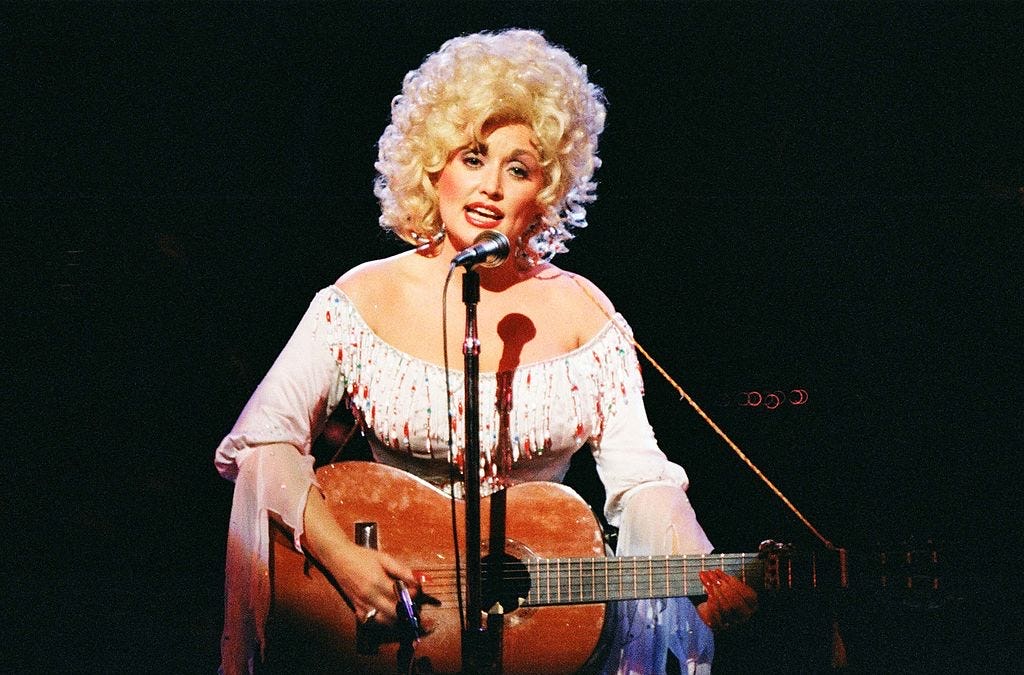
The first concert Caitlin Flanagan ever attended was at the San Rafael Civic Center in 1977. The performer was Dolly Parton. This was the Bay Area, and the idea that a country singer from the rural South might command a national audience — let alone one in San Francisco — was, as Flanagan puts it, 'years away.'
She and her friend Annie were, by her own account, weirdos. That same year they had gone to see professional wrestling at the Cow Palace. They were not following the herd. They knew what they liked.
What they liked, at the root of it, was a voice. Flanagan points readers directly to Parton's recording of Mule Skinner Blues (Blue Yodel No. 8) as the answer to any question about how so large a career became possible. The voice came first. Everything else followed.
The biography Flanagan sketches is spare and striking. Dolly Parton was born in 1946 in a Tennessee holler, the fourth of 12 children. Her father was, in Flanagan's words, 'an illiterate sharecropper turned subsistence farmer.' The family lived in a one-room cabin on the banks of the Little Pigeon River — a way of life, Flanagan writes, 'so remote from the modern American one that it seems like something from a children's book.'
The cultural distance between that origin and national stardom was not bridged quickly. In the 1970s, Flanagan recalls, 'the South and the rest of America were eager to ignore each other's existence.' There was Hee Haw, a weekly variety show conceived as a Southern answer to Laugh-In. The comedy was cornpone, Flanagan concedes. But the music — Tammy Wynette, Johnny Cash, Charlie Pride, a young Dolly Parton — was, she argues, 'some of the best music in the country.' The audience that could see that was small. The Berkeley Dolly Parton cult, Flanagan notes drily, 'was a two-girl operation.'
It was the 1980 film 9 to 5 that gave Parton something closer to mainstream recognition. But Flanagan's argument is that the recognition arrived late, and that what it recognized was only part of the thing. The deeper root — a childhood 'drenched in one of the great American art forms: bluegrass music' — was already there, already formed, long before the cameras found her.
---
What Flanagan is really writing about is the gap between what a culture produces and what it is willing to see. Parton came out of conditions that most of the country preferred not to think about — subsistence farming, illiteracy, twelve children in a one-room cabin — and she carried that formation into a career that outlasted nearly every trend that tried to claim her.
There is a lesson in the sequencing. The voice was real before the fame was real. The craft preceded the celebrity by years. In an era that rewards the performance of authenticity over the thing itself, Parton's story is a useful corrective: what endures tends to be what was built on something solid, something learned early, something no press release wrote into existence. The record, in this case, is the music. It was always the music.