Larissa Phillips spent most of her adult life in Park Slope, Brooklyn, where the consensus on guns was, as she puts it, simple: 'They're bad; let's get rid of them.' She participated in conversations about holding manufacturers liable, about buy-back programs modeled on Australia's, about restricting ownership to 'highly trained, background-checked professionals.' She did not know anyone who owned a gun. The idea of owning one herself never crossed her mind.
Then she moved to a farm in a red part of upstate New York. And things changed.
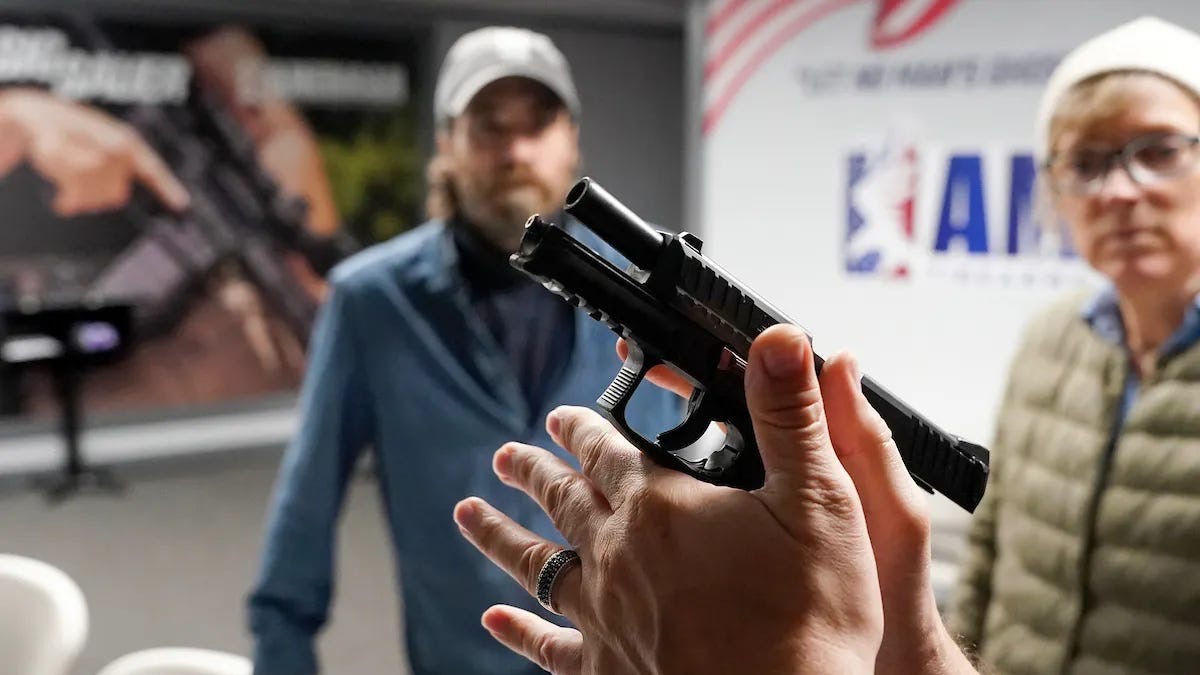
In an essay published this week at The Free Press, Phillips describes the moment she fired a pistol for the first time — jamming her palm against the grip, extending both arms, squinting through her glasses at the target. The bullet landed just a couple of inches south of the center circle. Her first reaction: 'Can I go again?'
The piece, introduced by Free Press editor Freya Sanders, is framed as a response to a broader question Sanders had posed after finding herself in an active-shooter situation in Washington, D.C.: Is the Second Amendment worth it? Does civilian gun ownership actually make the country more free?
Phillips, a British-born writer who has covered her own political evolution in previous essays for the outlet, is well-positioned to answer. She is not a convert who arrived at her new views easily or all at once. She still acknowledges the facts she grew up with: guns are involved in most murders; they escalate volatile situations; they land young men in prison; the Columbine massacre happened two weeks after her first child was born in 1999, and the image of holding her newborn while watching the news stayed with her for years.
What shifted was not the statistics. What shifted was the people.
Moving from one of the most liberal ZIP codes in the country to a community where firearms are part of daily life forced Phillips to reckon with something her Brooklyn years had not required: actually knowing the Americans who own guns, and understanding why. That process — slow, personal, grounded in place rather than ideology — is the through line of her essay.
She is now considering getting a handgun.
---
The Signal's read: this is a small story with a large implication. The debate over the Second Amendment has long been conducted at altitude — in legislatures, in law schools, in the comment sections of publications whose readers have never held a firearm. What Phillips describes is something more fundamental: the difference between a position inherited from a social environment and a view formed by direct experience.
Follow the incentive, not the press release. The incentive in a dense, policed, urban environment is to outsource your security to institutions. The incentive on a rural farm, miles from the nearest precinct, is different. Neither is irrational. But only one of those positions tends to get treated, in elite media, as the product of reason rather than culture. Phillips noticed the asymmetry. That, at minimum, is worth reading.