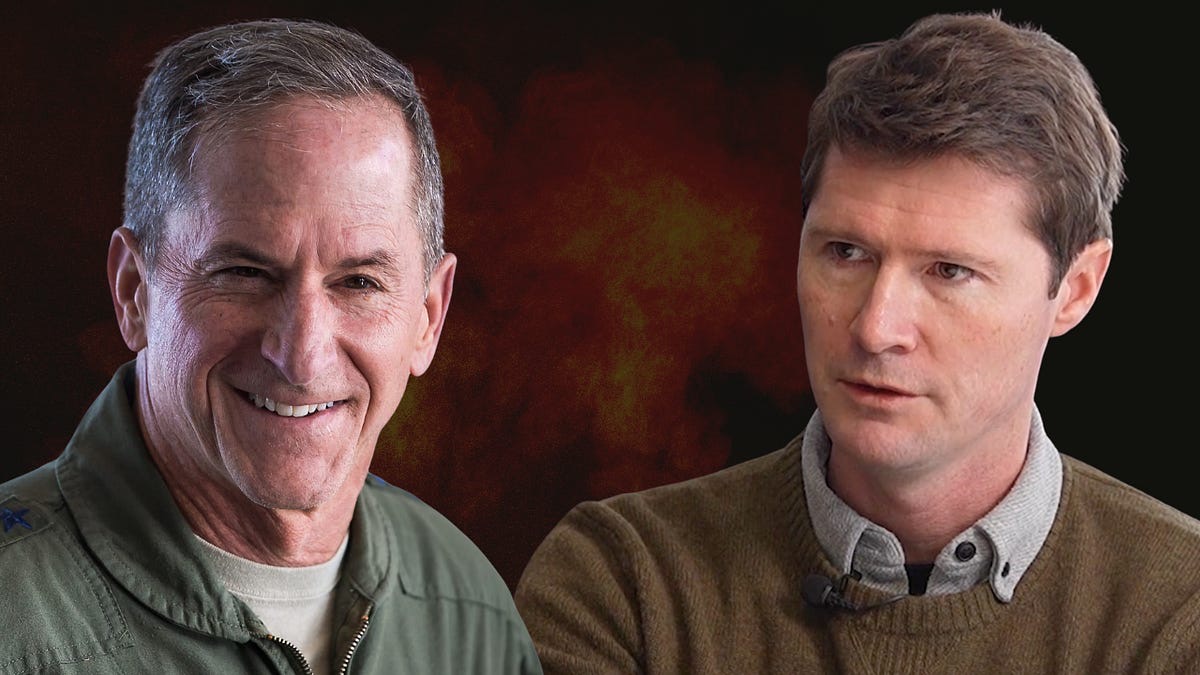
Retired Air Force General David Goldfein was shot down over Serbia in 1999. He survived. The rescue team sent to find him refused to leave without him.
That is the bare record, as Goldfein recounts it in a new episode of School of War, hosted by Aaron MacLean, released September 1, 2026. The episode runs one hour and three minutes.
Goldfein went on to serve as Air Force chief of staff, one of the service's most senior posts. In the conversation, he walks through how he stayed alive behind enemy lines, the mechanics of the rescue mission that pulled him out, and what the episode describes as the lessons of a career spent thinking about leadership and airpower — including, MacLean's introduction notes, how America deters its enemies.
MacLean, who hosts the podcast, is also a national security analyst at CBS News and a columnist at The Free Press. The episode is presented in the standard School of War format: a single extended interview, no panel, no press release gloss.
The source material here is thin by design — a podcast, not a briefing document — and it does not detail the specific missile, unit, or geography beyond "over Serbia," nor does it name the individual rescuers. What it establishes plainly is the shape of the story: a pilot shot down, a rescue team that did not withdraw, and a career built afterward inside the institution that trained him.
That sequence — service, crisis, extraction, and a return to command — is the kind of record that rarely survives contact with a press release. It survives, instead, in the testimony of the person who lived it, which is presumably why MacLean built an entire program around asking veterans to do exactly that.
There is a broader point worth making plainly. Deterrence is not an abstraction produced by policy memos in Washington; it is, at bottom, a promise made to the individual pilot that the country will come for him if something goes wrong. Goldfein's rescue is not merely a war story. It is evidence that the promise was kept in his case, at some cost and some risk to the men who came to get him.
The institutions that make that promise credible — training pipelines, combat search-and-rescue units, the chain of command that authorized the mission — do not generate headlines the way a single survivor's account does. But they are the reason the account exists at all. Follow the incentive, not the anecdote: an air force that cannot credibly promise rescue is an air force whose pilots fly differently, and whose adversaries calculate differently. Goldfein's later rise to chief of staff is a reminder that the people who make that promise credible sometimes end up running the institution itself.