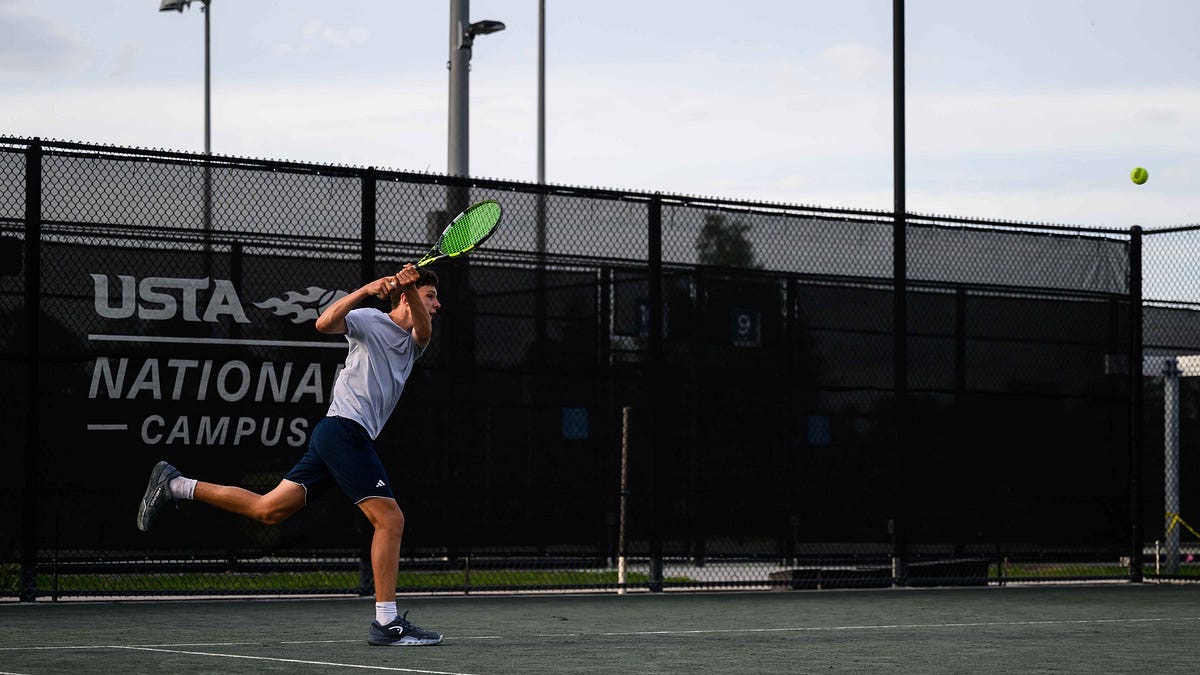
Macklin Nocera is 16. He has one goal: to play Division I college tennis. In January, he left Fordham Prep, a high school his father calls excellent, for an online school that lets him train four or five hours a day instead of four or five hours a week.
He plays at least two tournaments a month. He has given up hamburgers, desserts, dating, and most of what a normal American teenager's schedule holds. He works out with a personal trainer several times a week and travels to tennis academies in Spain, Florida, and Maryland.
The father, Joe Nocera, a senior editor at The Free Press, does not pretend this is cheap. He and his wife, Dawn, a former marathoner, call themselves 'Team Mack.' He writes that he can't bring himself to calculate the total but estimates it runs upward of $50,000 a year. Dawn manages Mack's conditioning; Joe scours tournament schedules for events that will raise his son's rating, the number college coaches actually look at.
Tom Farrey, who runs the Aspen Institute's Sports & Society Program, told Nocera that research from his program found the average sports parent spends almost three and a half hours a day on a child's athletics. Nocera says his first instinct was to deny it applied to his family — then, tallying the laundry, the restringing, the tournament weekends, he conceded it probably does.
Nocera writes that he feels no regret about the path his son has chosen, or about the effort he and his wife have put into helping him pursue it.
The record here is a household budget, not a policy debate, and that is precisely the point. No agency mandated this spending. No subsidy underwrites the academies in Florida or the trainer's hourly rate. A family weighed a trade-off — money, time, a conventional high school experience — against a son's stated ambition, and chose to bear the cost themselves.
That is what a free society looks like at the kitchen-table level: parents deciding, without a bureaucrat's permission, how to spend what they've earned on what they value. The market obliged them with academies, online schooling flexible enough to fit a training schedule, and a private trainer willing to show up several times a week. None of that required a government program; it required willing buyers and willing sellers.
Critics of youth sports culture will note the risks — burnout, injury, a childhood narrowed to one racket. Those are real costs, and Nocera does not hide them; he names the food given up, the dating forgone, the four-hours-a-day. But he weighs them against a goal his son chose at five years old and never abandoned, and decides the trade-off was worth making.
What is true here does not need an adjective. A family spent its own money, on its own terms, pursuing a goal set by their child rather than by any institution. Whatever one thinks of travel tennis, that is a decision that belongs to them, not to us.