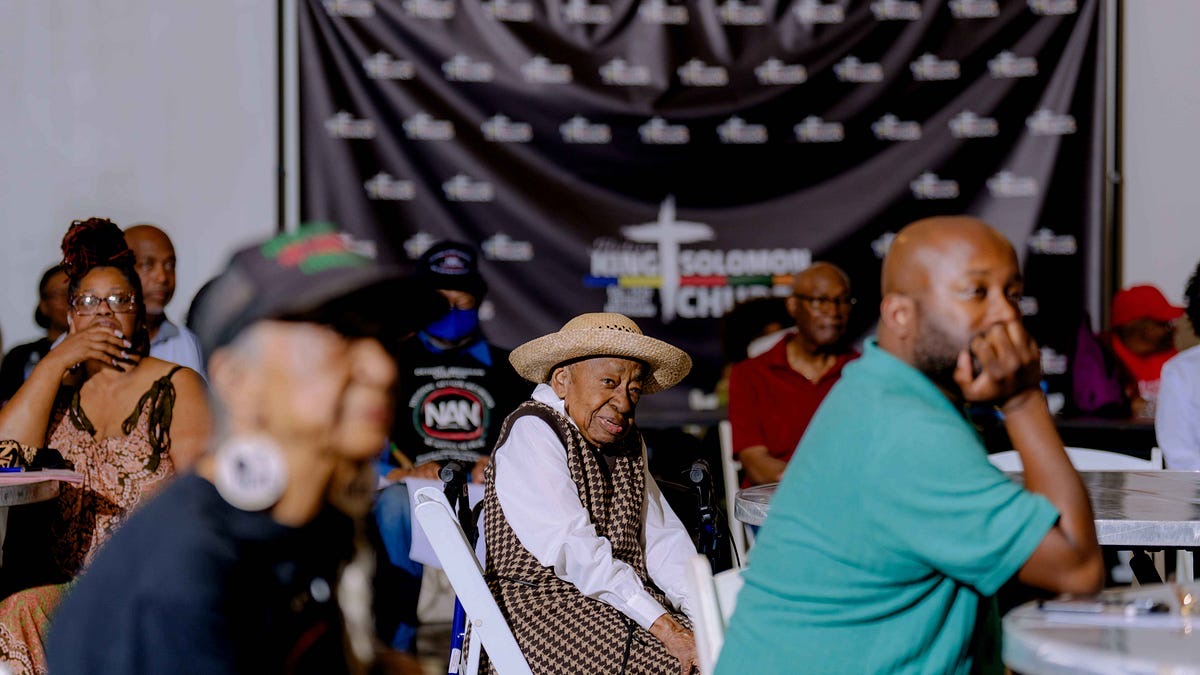
DETROIT — On a rainy Saturday afternoon on Livernois Avenue, Representative Haley Stevens spotted a Black woman in a bedazzled 'I ♥ Jazz' T-shirt and high-fived her on the spot. 'Yeah, that's right,' Stevens said. 'Your girl here!'
She reminded the couple that Tuesday is the last day to vote in a Senate primary that, according to The Free Press, is 'the Senate race the country is watching.'
For months, Stevens — a moderate — has been trailing in the polls behind Abdul El-Sayed, whom The Free Press describes as an 'anti-Israel populist' and 'progressive insurgent.' Then a poll released earlier this month showed Stevens up 46 points among Black voters. That number helps explain why Stevens, 43, was walking the streets of Sherwood Forest, a prominent Black community north of Seven Mile Road, in the rain.
The dynamic on the ground is personal, almost tactile. Stevens is, by any observer's account, a tactile politician: a hugger, a hand-holder, the kind of candidate who tells one voter 'I love you' and greets another with 'Hi, handsome, how are you?' She complimented a man's T-shirt reading 'THE WORLD HAS ALWAYS NEEDED AFRICA' in all caps. She is carrying, as The Free Press puts it, 'the weight of the Democratic establishment on her shoulders' — and she is doing it, remarkably, at ease.
The stakes for Democrats are real. Stevens has positioned herself as the establishment's best hope of holding the seat and keeping a path open to retaking the Senate chamber in November. El-Sayed's rise reflects a broader leftward pull inside the Democratic Party — one that moderate incumbents across the country are watching nervously from their own districts.
What the Michigan race clarifies, plainly, is a tension the Democratic Party has not resolved: whether its future belongs to the progressive insurgency or to the coalition-building center that Black voters in cities like Detroit have historically anchored.
Follow the incentive, not the press release. Stevens is not in Sherwood Forest because the data is ambiguous. She is there because a 46-point advantage among Black voters is the one number in her polling that looks like a lifeline — and she knows it. Whether that advantage holds through Tuesday is the question her campaign cannot yet answer.
The record here is instructive regardless of outcome. Establishment Democrats have learned, repeatedly, that urban Black voters do not move as a monolith on command — they move when a candidate shows up, in person, in the rain, on a Saturday. Stevens appears to have absorbed that lesson. Whether it is enough is what Tuesday will tell us.