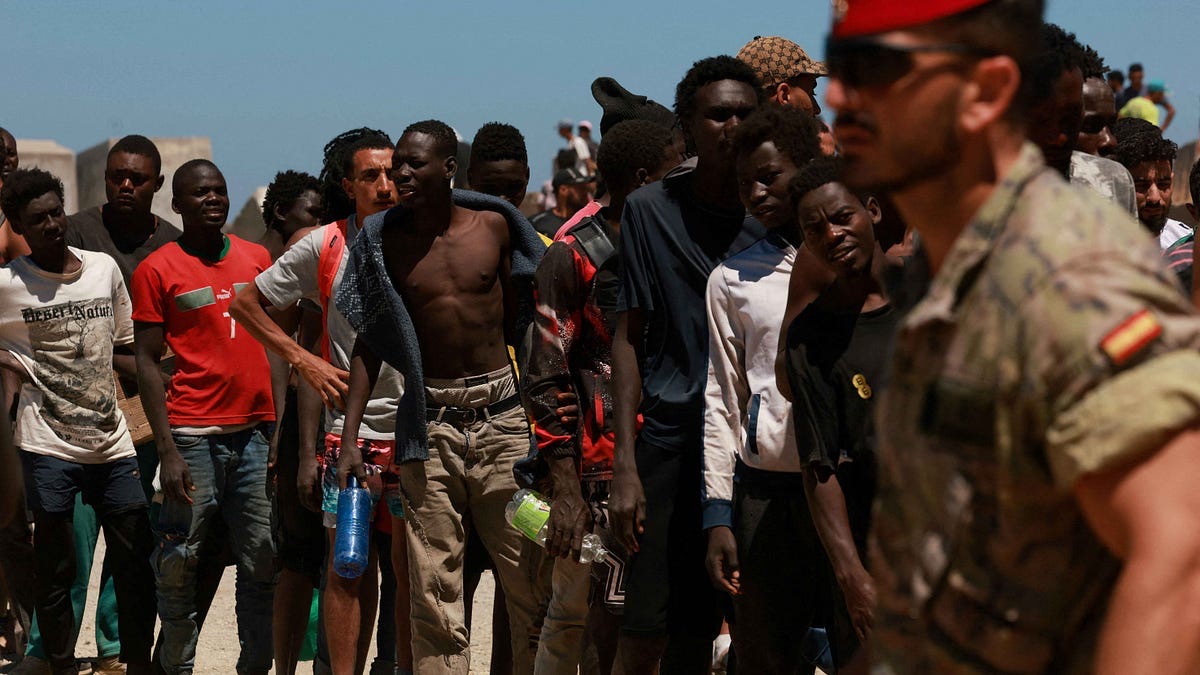
The images were stark enough: tens of thousands of people wading across the border into Ceuta, the Spanish enclave on the northern tip of Africa, in the span of a single day. Spain moved troops and resources to push migrants back. The immediate debate in European capitals centered, predictably, on border policy.
But according to Zineb Riboua, a research fellow at the Hudson Institute and founder of its China in MENA Project, the European frame misses the more consequential story. Writing in The Free Press, Riboua argues that to understand what happened in Ceuta, you must first understand what is happening inside Morocco.
A monarchy under pressure
Morocco is a semi-constitutional monarchy. King Mohammed VI governs alongside an elected parliament where Islamist, secular, and nationalist parties compete for influence. That competition has always carried tension. But a separate category of Islamist groups — ones dedicated to challenging the legitimacy of the monarchy itself — also operates inside the country, according to Riboua. Their objection is theological: the king, in their view, does not conform to their interpretation of Islamic law and governance.
That pressure intensified after Morocco normalized relations with Israel under the U.S.-brokered Abraham Accords. The government that signed the agreement was itself Islamist-led. But many of the political actors involved later challenged normalization after leaving office, according to Riboua, using Palestinian narratives following October 7 to mobilize domestic opposition against the crown.
The result, Riboua argues, is a Moroccan state caught between its own modernizing trajectory and radical actors who see every point of external pressure — a diplomatic agreement, a border incident, a viral image — as an opportunity to weaken the monarchy's legitimacy at home.
What the competing narratives miss
In the days after the crossing, two rival explanations circulated online. One held that the Moroccan government itself orchestrated the surge as a geopolitical signal to Madrid and Brussels. Another, according to Riboua's account of the online debate, attempted to implicate Israel. Riboua treats both as insufficient — the kind of single-actor explanations that flatten a more complicated domestic dynamic.
Spain has since deployed troops and resources to Ceuta. The immediate border situation has stabilized. The underlying conditions have not.
The Signal's read
What Ceuta illustrates is a principle that European policymakers have resisted for years: migration flows are downstream of political order, and political order is downstream of institutions, legitimacy, and the rule of law. When radical actors work systematically to erode a government's authority — using religion, foreign-policy grievances, and social media as instruments — the consequences do not stay inside the country's borders. They arrive on Europe's shores, often within hours.
The instinct in Brussels and Madrid will be to treat this as a logistics problem: fences, coast guard vessels, bilateral aid packages. Those tools are not nothing. But they address the symptom. The record on ignoring the source — ideological movements that regard stable, modernizing states as enemies — is not encouraging. Follow the incentive, not the press release. The actors who benefit from Ceuta's chaos are not the migrants themselves.