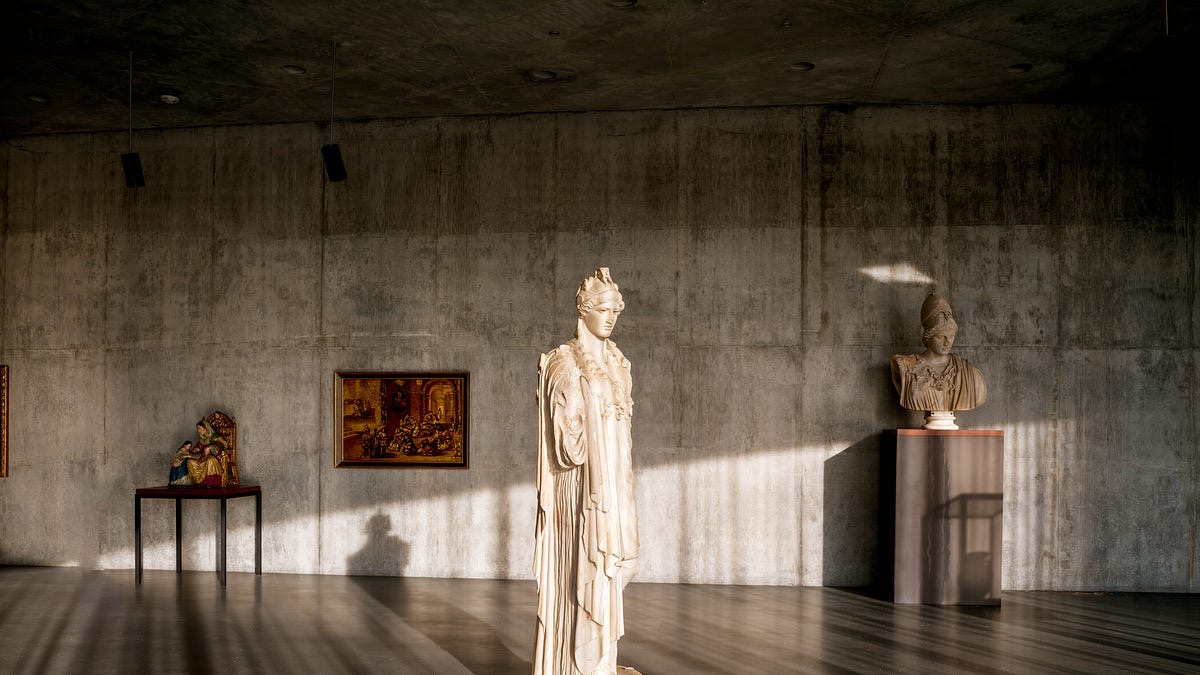
The Los Angeles County Museum of Art was once the largest encyclopedic museum west of the Mississippi. It is no longer that. It is, according to Free Press columnist Caitlin Flanagan, something closer to 'a sinister garage sale.'
Flanagan visited the newly renovated LACMA three times over two weeks. What she found was not a reimagined institution. It was a dismantled one. Sumerian relief structures sit next to black-and-white photographs. A performance artist on a bicycle pedals through the galleries, depending on the day. The organizing logic that once allowed visitors to understand how one era followed another, how new styles were born, how artists are linked across centuries — that logic is gone.
Michael Govan, the museum's CEO, frames the new arrangement as an intellectual project. 'We're going to create knowledge by putting things in categories and distinguishing,' he told Flanagan. She is not persuaded. 'Would it be churlish,' she asks, 'to point out that if people hadn't been creating knowledge by putting things in categories and distinguishing, Govan wouldn't be able to preside over a museum that hangs in midair?'
The philosophy behind the renovation is not new. Critical theory — the doctrine that the Western canon reflects racism, colonialism, and bigotry rather than any objective sense of truth and beauty — has been a fixture of academic art circles for decades. What is new is its full institutional capture. LACMA is not a university seminar. It is a public museum funded to preserve and transmit knowledge. When that mission is replaced by a theory that treats hierarchy itself as the problem, the institution stops doing its job.
The record here is worth reading carefully. The argument is not that LACMA must be frozen in amber, or that non-Western art has no place in a great encyclopedic collection. The argument is simpler: context is not oppression. Chronology is not colonialism. Knowing that a Sumerian relief predates a 20th-century photograph by several thousand years is not an act of cultural aggression — it is the minimum condition for understanding either object.
Flanagan's conclusion is blunt. 'I visited the new LACMA three times over two weeks, and it radicalized me,' she writes. 'Here was the first museum I've ever wanted to tear down.'
---
Say it plainly: what was destroyed at LACMA was not a relic of exclusion. It was accumulated knowledge — the kind that takes generations to build and an ideological renovation to erase. Future visitors, especially those who arrive without the background to fill in what the institution no longer provides, will pay the steepest price. They will stand in front of objects stripped of their context and be told that the absence of context is, itself, a form of liberation.
Follow the incentive. The people who redesigned LACMA will not suffer for it. They will collect awards, give lectures, and move on. The loss belongs to the public — the taxpayers and donors whose resources built the collection — and to the generations who will inherit a museum that chose theory over knowledge, and called the trade-off progress.