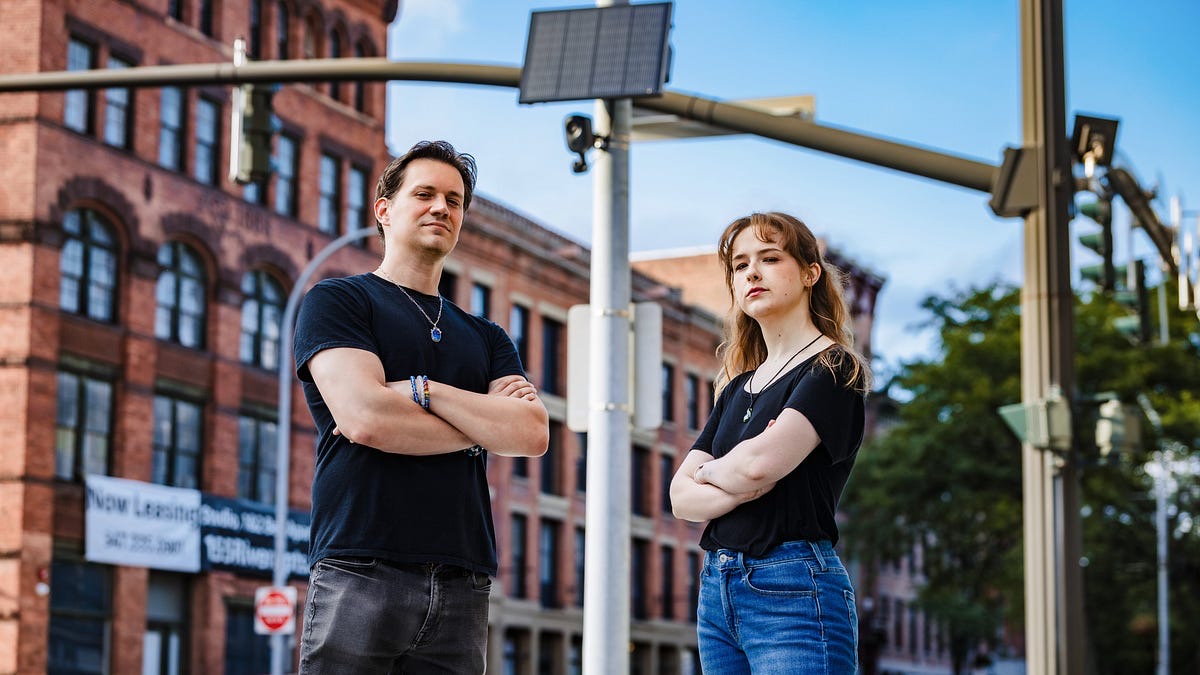
On a Friday night in downtown Troy, New York, Rachel Stewart, 32, is sipping a White Claw on a stoop and invoking the American Revolution. 'In 1776, the statue of King George in Bowling Green was toppled, beheaded, and melted into bullets for the Continental Army,' she said. 'And we will do the same thing to the Flock cameras if we need to.'
Stewart is a Revolutionary War reenactor — she says she can fire any musket or rifle from the years 1775 to 1865 — and she is one of a group of young, middle-class liberals in Troy who have declared war on Flock Safety, a private technology company that has spent the last nine years installing more than 100,000 license-plate-reading cameras across the country.
Troy is a historic city of about 50,000, located seven miles from Albany. It is an unlikely front line. But the fight here has become a focal point for a broader national argument about what happens when private surveillance infrastructure is woven into the daily operations of local government.
The record on Flock is not flattering. Last year, according to reporting by The Free Press, Flock's national search tool was used by a Texas sheriff's department to track down a woman who had self-administered an abortion. Critics have also raised concerns that Immigration and Customs Enforcement and Customs and Border Protection are able to access Flock data through local police departments, effectively using a private network to conduct immigration enforcement without direct legal accountability.
Then there is the automation problem. When Flock detects a license plate flagged as stolen, it automatically dispatches police to stop the vehicle. Data entry errors have caused multiple people to be pulled over by armed officers and accused of stealing their own cars. One case involved a 76-year-old grandmother in Colorado who was stopped multiple times and had to contact a local television news station before the error was corrected.
These are not abstract civil-liberties hypotheticals. They are documented outcomes of a system that pairs private data collection with the coercive power of the state — and that operates largely outside the public procurement and oversight structures that would apply to a government-run program.
Say it plainly: the problem with Flock is not the camera. The problem is the architecture. A private company holds the data; local police access it; federal agencies reach it through those local relationships; and the individual whose plate was scanned has no meaningful notice, no clear recourse, and no vote on any of it. The liability, when errors occur, lands on the grandmother in Colorado, not on the vendor.
The activists in Troy are, by their own description, middle-class liberals. Their instinct — to invoke the Revolution, to talk about toppling things — is more theatrical than practical. But the underlying concern is one that cuts across the usual political lines. Surveillance infrastructure built by private capital and operated through public law enforcement is not a free-market outcome. It is a subsidy to one company's business model, paid in the currency of civil liberty. Follow the incentive, not the press release: Flock's growth depends on expanding the network, and every new municipal contract is a new node. The residents of Troy did not vote for 100,000 cameras. They are simply in them.