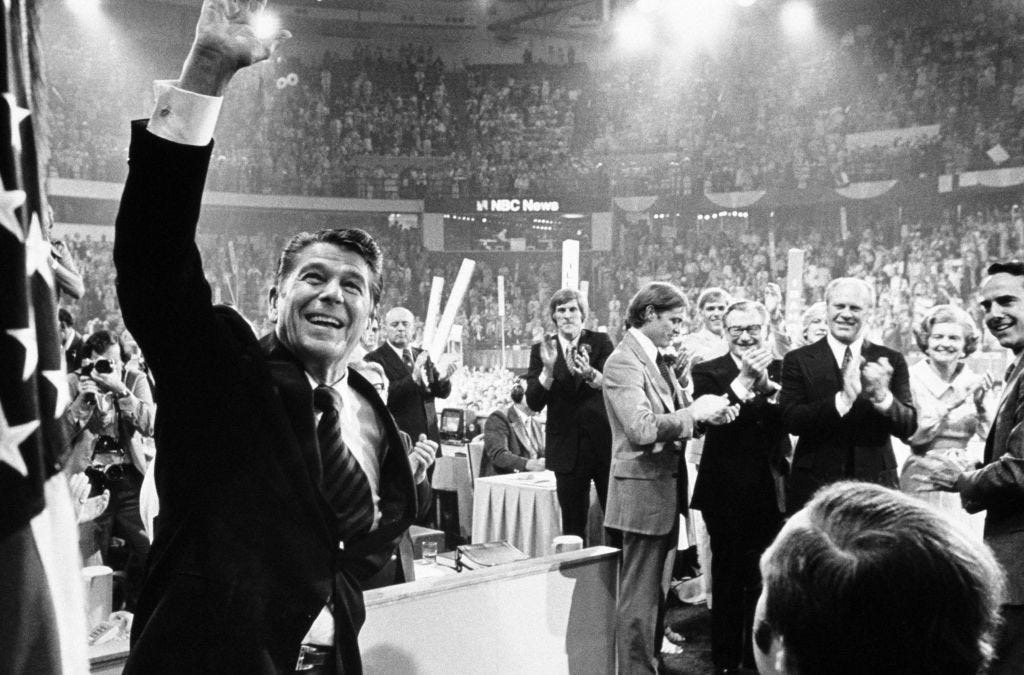
The margin was 117 votes. On August 19, 1976, Gerald Ford secured the Republican presidential nomination on the first ballot — 1,187 delegates to Ronald Reagan's 1,070 — and the conservative insurgency that had shaken the GOP establishment all year came up just short.
Reagan had earned the right to be bitter. He had run hard, come back from an early deficit, and watched a late strategic gamble — pre-selecting Pennsylvania senator Richard Schweiker, a liberal Republican, as his running mate — alienate the conservative base he needed most. Ford, who had never been elected to the presidency or the vice presidency, held the incumbency advantage and used it. The last contested Republican convention in modern history ended the way most contested conventions do: the institution protected itself.
And then Reagan spoke.
With nothing prepared, he addressed the convention hall in Kansas City and posed a question that had nothing to do with the vote just taken. What, he asked, would people of the future think if they opened a time capsule a hundred years from now? Would they believe that Americans had met the challenges of their moment?
The question was not rhetorical decoration. It was a first-principles argument — the kind Reagan returned to again and again — that politics is not about the next election but about the kind of country you are handing forward. The delegates who had just voted against him stood and cheered.
The context matters. Ford had inherited the presidency under circumstances that had never occurred before in American history. Spiro Agnew had resigned the vice presidency in 1973 over a bribery scandal tied to his time as governor of Maryland. Ford, a long-serving Michigan congressman, was appointed in his place. Then Nixon himself resigned over Watergate, and Ford ascended to the Oval Office without a single national vote cast in his favor. Reagan — who had been governor of California and had sought the GOP nomination against Nixon in 1968 — believed he, not Ford, represented the party's legitimate future.
He was right, as it turned out. Ford lost to Jimmy Carter that November. Four years later, Reagan won the presidency in a landslide, and the speech in Kansas City is now understood as the moment the movement consolidated around a man rather than a platform.
---
Fifty years on, the Kansas City speech deserves more than nostalgia. It is a case study in what political leadership looks like when stripped of its tactical scaffolding. Reagan had lost. His Schweiker gambit had failed. The hall belonged to someone else. None of that stopped him from making the argument he believed was true.
That is the standard worth remembering — not the electoral math, not the delegate count, but the willingness to ask, in a room full of people who just voted against you, whether the country is living up to what it owes the future. The question Reagan posed in 1976 has not expired. It is, if anything, more pressing now than it was then.