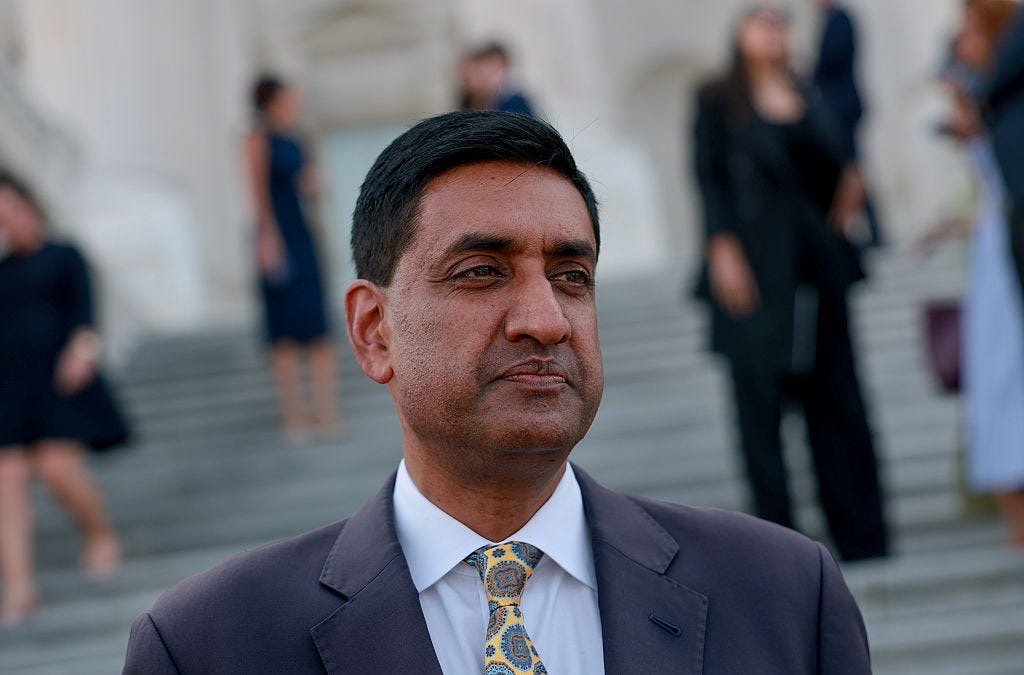
Representative Ro Khanna, the California Democrat who has positioned himself as a 2028 presidential contender, posted a video on X on Monday declaring that 'black families are sounding the alarm about the unexplained deaths of their loved ones, including a disturbing number of black Americans found hanging from trees.'
He named three people he said fit the pattern. Juliana Nzita was found hanging from a tree in a North Carolina churchyard in May. Tasia Fortune was discovered in August outside an abandoned house in Jackson, Mississippi. Nolan Wells drowned in July in uncertain circumstances after a boat outing with three white friends on Mississippi's Gulf Coast.
The framing was deliberate and the implication unmistakable: a wave of racially motivated killings, hidden in plain sight, demanding a national reckoning. The video was designed to travel, and it did.
What it was not designed to do was wait for the facts.
The deaths Khanna cited are, by his own description, unexplained or under investigation. Unexplained is not the same as lynching. Uncertain circumstances are not evidence of a pattern. Grouping three tragedies under a single inflammatory headline — before investigations are complete, before families have answers, before any law enforcement body has established a connection — is not advocacy. It is the conversion of grief into content.
This is not Khanna's first recent venture into the attention economy at the expense of precision. According to The Free Press, the congressman has in recent months revived what the outlet describes as discredited theories surrounding the Epstein files and attempted to turn a clash with Israeli settlers into 'a full-blown international incident.' The pattern is consistent: find the most combustible material available, post before the facts settle, collect the engagement.
The cost of that pattern is real, even when the politician moves on. Families of the deceased are left inside a story that has been nationalized and politicized before any truth has been established. Investigators face public pressure shaped by a narrative that may not survive scrutiny. And the public — which deserves honest information about whether racial violence is rising, holding steady, or declining — receives instead a viral frame built on three data points that have not been verified as connected.
Race is the oldest and most sensitive fault line in American political life. That is precisely why it demands more discipline, not less, from people who hold public trust. The incentive to be first, to be loudest, to be the congressman who 'sounded the alarm' is obvious. The trade-off — accuracy, fairness to the dead, the integrity of ongoing investigations — is less visible on a Monday afternoon when the post is climbing.
Say it plainly: a lawmaker who names grieving families in a viral video, before the evidence supports his conclusion, is not protecting those families. He is using them. The record is public. The consequences of that use — for the families, for the investigations, for the public's ability to reason clearly about race and violence — will outlast the engagement numbers by a considerable distance.