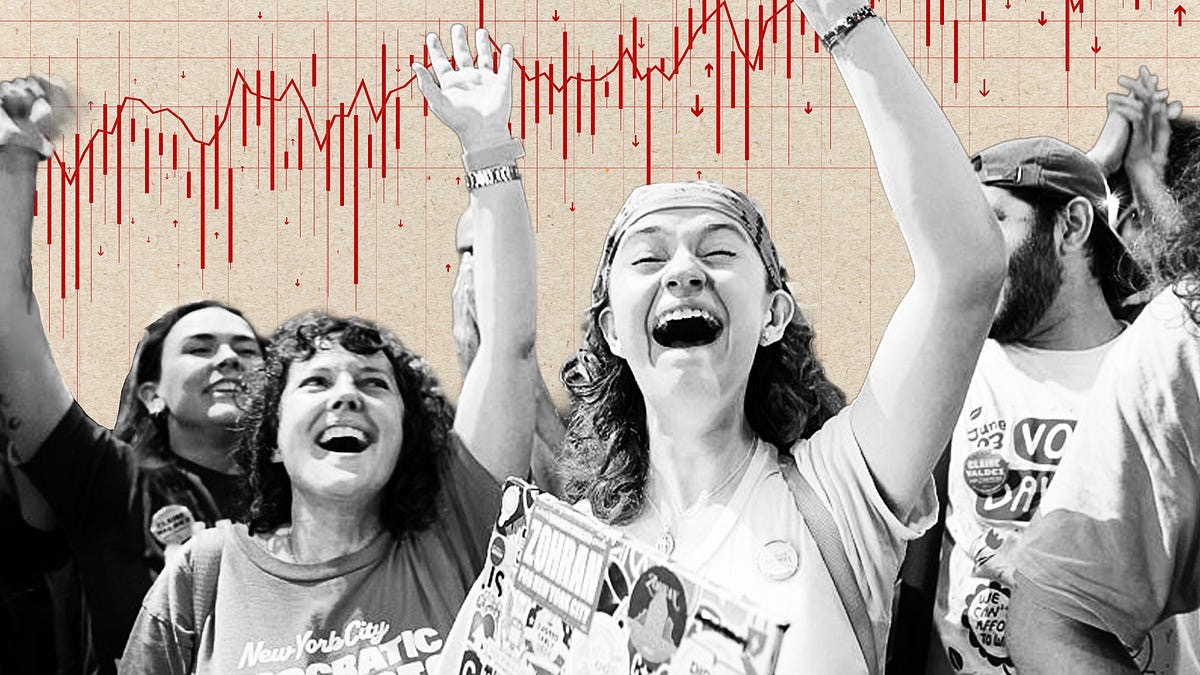
The numbers are striking enough to demand a straight reading before any interpretation. Nearly two-thirds of Americans between the ages of 18 and 29 now hold a favorable view of socialism, according to recent polling cited by Arthur Brooks in The Free Press. Candidates aligned with the Democratic Socialists of America — a organization that officially advocates abolishing Immigration and Customs Enforcement and nationalizing large corporations — have won primary contests across the country. And Zohran Mamdani, a self-described democratic socialist who took New York City's mayoral seat last November, currently carries a favorability rating of 58 percent.
That is the record. Say it plainly: the left's populist surge is real, measurable, and not confined to social-media noise.
The question is what it means. One interpretation, popular among its advocates, is that this is the inevitable terminus of American politics. Capitalism, the argument runs, has produced the world's first trillionaire while millions cannot cover rent or groceries. Inequality deepens; only radical structural change can reverse it. Democratic socialism is not a phase — it is the destination.
Brooks, a behavioral scientist and Vanderbilt professor, offers a competing hypothesis. 'Democratic socialism, as we see it today, is a fad,' he writes. 'Although it might wreak some havoc in the near future, it will collapse, to be remembered merely as a passing political fancy.' His reasoning draws on a principle worth taking seriously: when a belief system appears rapidly, when social pressure enforces conformity to it, and when dissent carries a reputational cost, the movement is more likely driven by social contagion than by durable conviction.
Follow the incentive, not the press release. Young voters facing stagnant wages, expensive housing, and student debt are not irrational for looking at the system and finding it wanting. The frustration is real. The diagnosis, however, does not automatically validate the prescription. History's ledger on nationalized industries and abolished enforcement mechanisms is public, and it is not favorable to the consumers and workers those policies claim to serve.
What the record also shows is that economic freedom — property rights, open markets, limited bureaucratic interference — has lifted more people out of material poverty than any alternative system yet tried. That is not an ideological assertion. It is the most replicated finding in development economics.
---
The Signal's read is this: a fad can still do real damage before it breaks. Primary victories translate into legislation; municipal experiments in nationalization or enforcement abolition have consequences that outlast the enthusiasm that produced them. The taxpayer, the small-business owner, the immigrant navigating a legal process — none of them benefit from policies adopted because they were socially costly to oppose.
Brooks's framework — treat sudden, pressure-enforced belief shifts with suspicion — is not a partisan heuristic. It is a first-principles discipline that applies equally across the spectrum. But right now, in this political moment, it is the democratic-socialist wave that is moving fast, punishing dissent, and promising transformation without a working model. The honest question is not whether the frustration behind it is legitimate. It plainly is. The question is whether the solution on offer has ever actually worked — and for whom.