A few days ago, Yuan Yi Zhu, an academic and writer, had lunch with a friend. The friend is, by Zhu's account, an exceptional scholar with a stellar publication record and a strong résumé. He has spent years in the postdoctoral halfway house — neither permanent faculty nor fully outside academia. He is now ready to leave the profession entirely, planning one final year on the job market before walking away for good.
Zhu could not stop thinking, over that lunch, about another young scholar who had won spectacularly while his friend had lost.
Jason Arday holds a full professorship in sociology of education at the University of Cambridge. Cambridge's press office has made a point of noting that he is the youngest black person ever to hold a full professorship at the university. On paper, his story was striking: from an immigrant background, autistic, unable to speak until the age of 11, learning to read and write only at 18. During his PhD studies, he reportedly pinned a note on his bedroom wall that read, 'One day I will work at Oxford or Cambridge.'
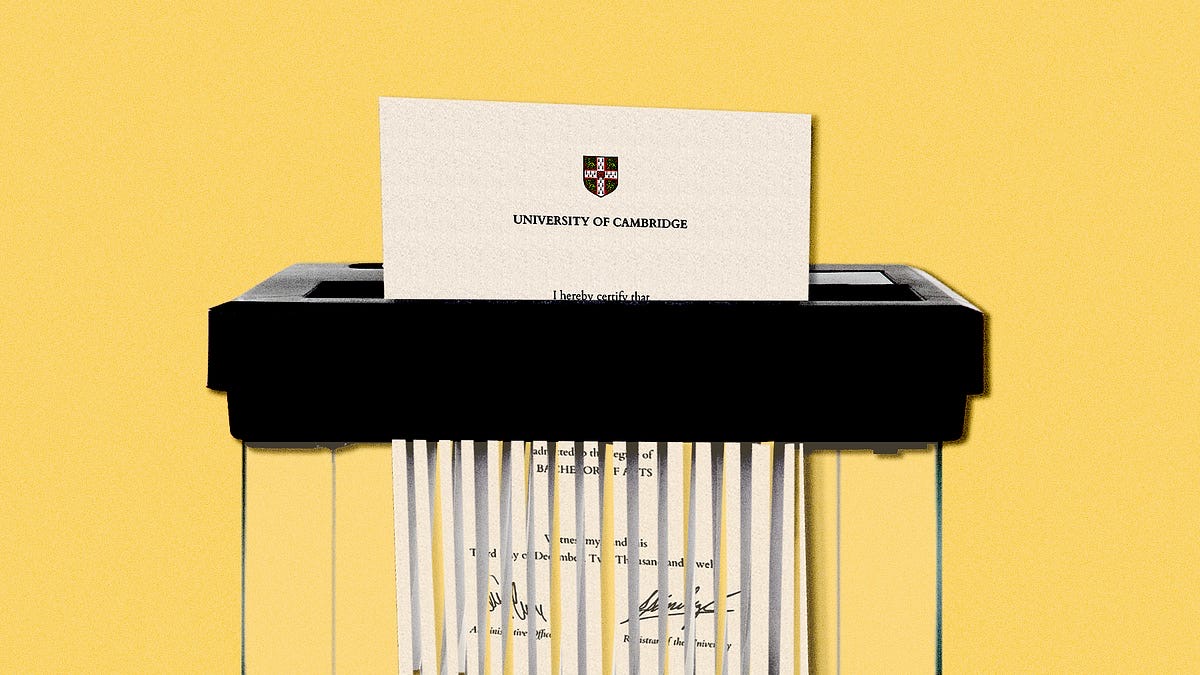
That story is now at the center of a plagiarism scandal.
Zhu's piece in The Free Press frames the Arday case as a symptom of something larger: universities that, in Zhu's words, still act as though it is 2020 — the high-water mark of institutional DEI commitments — long after the broader culture has moved on. The question Zhu raises is not merely about one professor's conduct. It is about the system that elevated him and the people that system passed over to do it.
The arithmetic is straightforward. Academic positions are finite. When an institution hires on criteria other than merit — and then protects that hire when the record comes into question — someone else does not get the job. That someone else is, more often than not, a scholar like Zhu's friend: qualified, diligent, playing by the rules, and losing anyway.
Cambridge's press office has leaned hard into the 'youngest black professor' framing. What that framing does, whether intentionally or not, is make any scrutiny of Arday's record feel like an attack on representation itself. That is precisely the mechanism Zhu is identifying. The diversity credential becomes a shield. The shield makes accountability harder. And the people who bear the cost are the ones the institution never bothered to celebrate.
Say it plainly: the scandal at Cambridge is not, at its core, about one man's résumé. It is about what happens when institutions treat a hiring decision as a values statement rather than a professional judgment. Values statements are hard to audit. Professional judgments are not.
The record is public. Cambridge built a press strategy around Jason Arday's identity. That strategy now sits alongside a plagiarism finding. The university will have to decide which it cares about more — and the scholars waiting outside the gate will be watching closely when it does.